

Support for China’s property sector
The package of support for the property sector had the biggest impact on sentiment – some 17 property developers have announced financing plans since the government ended a fundraising ban, with 13 expected to get a combined CNY90bn ($13bn).
Despite the recent thaw in sentiment, the future remains uncertain, as the US Federal Reserve (Fed) and other major central banks have committed to continue hiking interest rates to calm inflation.
On 2 March, the Fed raise rates for the secon time in 2023, by 25 basis points (bps), pushing benchmark borrowing rates to a target range of 4.75% to 5.00%.
Such high interest rates are widely expected to cause problems in the future, as they are likely to reduce demand from key steel consumers such as the automotive and construction industry.
Are you interested in learning more about steel commodity prices and their outlook? In this article, we'll look at recent news affecting the market, along with analysts’ latest steel price predictions.
Geopolitical instability drives steel market uncertainty
In 2021, the US HRC steel price trend was up for most of the year. It hit a record high of $1,725 on 3 September 2021 before falling in the fourth quarter.
US HRC steel prices have been volatile since the start of 2022, mostly maintaining a downward trajecotry. According to CME steel price data, the August 2022 contract started the year at $1,040 per short ton, and fell to a low of $894 on 27 January, before rebounding above $1,010 on 25 February 2022 – the day after Russia invaded Ukraine.
The price rallied to $1,635 per US short ton on 10 March on concerns about disruptions to steel supply. But the market turned bearish in response to lockdowns in China, which dampened demand from the world’s largest steel consumer.
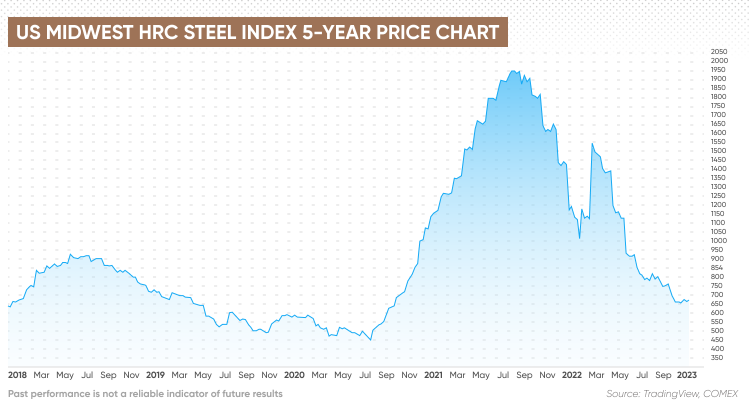
HRC steel ended 2022 trading at $666/T – 53.68% down since the start of the year.
So far in 2023, the price has seen a steady incline, largely helped by the ending of Covid lockdowns in China. In the first three months of the year it rose 55.4% from $749 to $1,164. As of 6 April, it was at $1,165.
In its Short Range Outlook (SRO) for 2022 and 2023, the World Steel Association (WSA), a leading industry body, said:

In a piece on the EU construction sector in early September, ING analyst Maurice van Sante highlighted that expectations of lower demand globally – not just in China – were putting downward pressure on the price of the metal:

China’s steel demand falls on zero-Covid policy
China is both the world’s largest steel producer and consumer, accounting for more than half of global output and finished steel demand. According to the WSA, China produced 1,032.8 billion tonnes of crude steel in 2021 – equivalent to 52.9% of global output. The country consumed 666.5 million tonnes of finished steel products, equivalent to 51.9% of global apparent steel use in 2020.
As part of China’s zero-Covid policy, the country imposed strict lockdown measures in Shanghai in April 2022. Shanghai is China’s key financial hub and one of the nation’s major ports. The restrictions severely disrupted the country’s import and export operations, hitting Chinese economic growth in the second quarter. As the disease permeated throughout other areas of the country, the authorities reacted accordingly, imposing restrictions in line with the zero-Covid outlook.
Steel price forecast: Should you go long or short?
According to a recent forecast by information provider S&P Global, hot-rolled coil prices in Europe and the United States could potentially stay around the $800/metric tonne level throughout Q4 2022 and extend into 2023:

Algorithm-based forecaster WalletInvestor was bullish in its long-term forecast for the US HRC price as of 6 April. The site predicted that the price could end 2023 $1,047.047 and continue to climb in the coming years. Wallet Investor’s steel price forecast for 2025 saw the price rising to $1,516.411 by year-end.
Due to the heightened uncertainty and volatility in the market, analysts have tended to refrain from giving a long-term steel price forecast for 2030.
Note that predictions can be wrong and that analysts’ steel price forecasts shouldn’t be used as a substitute for your own research. Always conduct your own due diligence before investing, and never invest or trade money you cannot afford to lose. Keep in mind that past performance is no guarantee of future returns.


